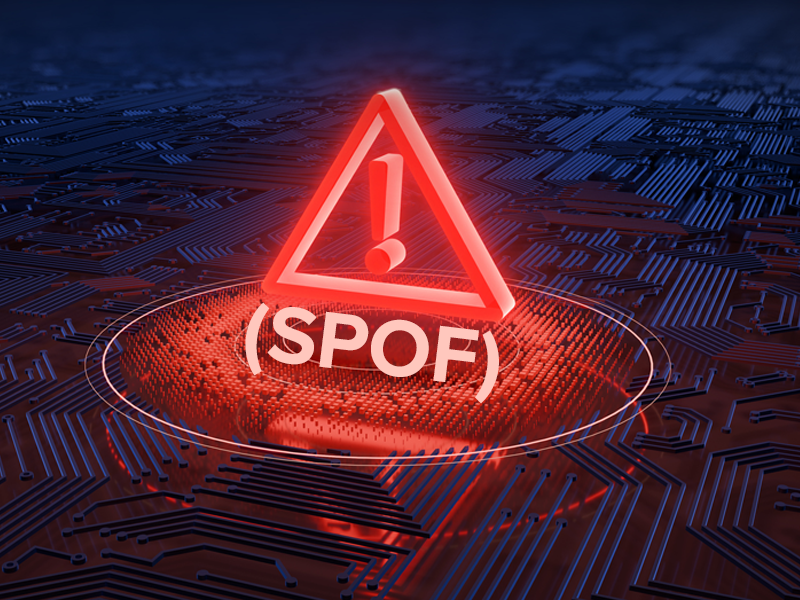
A single point of failure (SPOF) is any component or element that, if it fails, can bring down the entire system. Modern companies with complex IT environments depend on the interaction of many moving parts to satisfy their business requirements. These diverse components include hardware, software, and administrative policies that control who can perform specific IT functions.
SPOFs pose risks that can lead to disastrous system outages or data loss. An SPOF can affect the IT environment’s reliability, security, and operational efficiency. Unfortunately, SPOFs can be hard to detect, especially when the existing environment meets business needs.
Many common failure points remain hidden until they cause an issue. IT decision-makers and support teams must identify and mitigate dangerous SPOFs before they impact the environment and business. Let’s look at some of the typical SPOFs that must be eliminated to protect your company.
Common SPOFs Your Company May Need to Address
Organizations should perform a comprehensive evaluation of their IT infrastructure and policies to uncover critical SPOFs.
Storage systems
Modern businesses rely on data access and need resilient storage solutions. A company’s storage systems represent crucial elements of its IT environment. Failed storage systems can render data inaccessible and result in immediate application outages. Teams must be aware of and take the necessary steps to alleviate the risks posed by the following specific storage-related SPOFs.
- Companies that use a single storage controller to manage all I/O operations risk losing access to all data if the controller fails. The risks extend to shared RAID controllers whose failure can make it impossible to access data from an array of healthy disks.
- A single network path to storage systems offers no alternative routes if a switch or interface card fails. The loss of the network path causes hosts and applications to lose access to data that is still online and should be accessible.
- Teams may face misconfigured asynchronous replication that does not support effective failover procedures. Data copies may exist, but not be promotable to handle an incident when needed.
- Companies may store mission-critical data in a single failure domain, such as an on-premises data center or a cloud region. Organizations without redundancy may lose all data access in a regional outage.
- Teams can inadvertently create an SPOF by poorly architecting backup or snapshot procedures. They should not store backups or snapshots on the same storage array or in the same cloud account as production data to guard against an array failure wiping out all copies.
- Companies using a single power supply or rack-level cooling can lose access to data if a hardware failure renders logically redundant storage inaccessible.
Identity and authentication systems
All parts of the IT environment depend on the proper functioning of identity and authentication systems. If identity solutions fail, users cannot access systems that require login, authorization, and validation. Companies must mitigate the following SPOFs affecting identity and authentication to ensure operational efficiency across the environment.
- Companies that rely on Microsoft Active Directory must guard against domain controller failures or disruptions by threat actors that can lock all users out of the environment. Other central directory services, such as Azure Active Directory, must be protected to avoid widespread authentication failures.
- Organizations using multi-factor authentication to enhance security typically engage a third-party MFA service. If no backup authentication method is available, a failure leaves users with valid credentials unable to complete the login process.
- Directory replication failures between domain controllers can result in failed logins and unpredictable authentication behavior.
- Admin accounts can be locked out due to failures in centralized identity solutions. Teams should implement privileged break-glass accounts to access and repair systems after an outage.
- Some identity platforms enforce rate limits and may throttle traffic to address usage spikes. This SPOF causes authentication failures despite healthy identity systems.
Backup and recovery systems
SPOFs affecting backup and recovery systems pose significant dangers that may remain hidden until your company needs them most. Organizations can become overconfident in their backup resilience, but face substantial recoverability issues that put the business at risk. Teams must make every effort to eliminate the following SPOFs related to backup and recovery.
- Companies should not store backups or snapshots on the same array in the same cloud account as live, production data. Doing so creates a very dangerous SPOF, where a hardware failure or ransomware attack can affect all copies of mission-critical data.
- A single, centralized backup server can fail or be compromised, making it impossible to manage backups or use them to restore systems and applications.
- Businesses should not store backups in a single repository or target, such as a NAS device or tape library. A hardware failure would result in the loss of access to all backup data.
- The lack of offsite or geo-redundant backups presents an SPOF that can be exploited by a regional disaster or compromised account. Ideally, offsite copies should be immutable so threat actors cannot corrupt them.
- Teams must test restore processes to avoid the SPOF of unrecoverable backups. Untested procedures often lead to extended recovery time and business disruptions.
- Lost or inaccessible encryption keys make it impossible for teams to use backups for recovery. Keys must be managed efficiently to ensure their availability to recover backup data.
Let VAST Help You Eliminate Your SPOFs
VAST’s solutions and services can be instrumental in eliminating the SPOFs that can damage your business. Our offerings cover your entire IT environment and can address many of the SPOFs that put your business at risk.
- Our storage management service leverages our strategic partnerships with leading vendors to develop and implement a redundant storage infrastructure that protects your valuable data.
- We partner with Semperis to offer superior protection for their Active Directory and Entra ID environments through our expert managed services, ensuring essential identity management for your Microsoft environment.
- Our Cloud Backup-as-a-Service (CBaaS) provides data protection and resilience with immutable backups tailored to your environment’s requirements.
- We provide Disaster Recovery-as-a-Service (DRaaS) to protect your business-critical systems with offlsite backup and recovery to alternate sites.
- Our expert team can manage your backups to eliminate SPOFs and fully protect your data.
Get in touch today and learn how we can help you identify and address SPOFs you didn’t know you had.